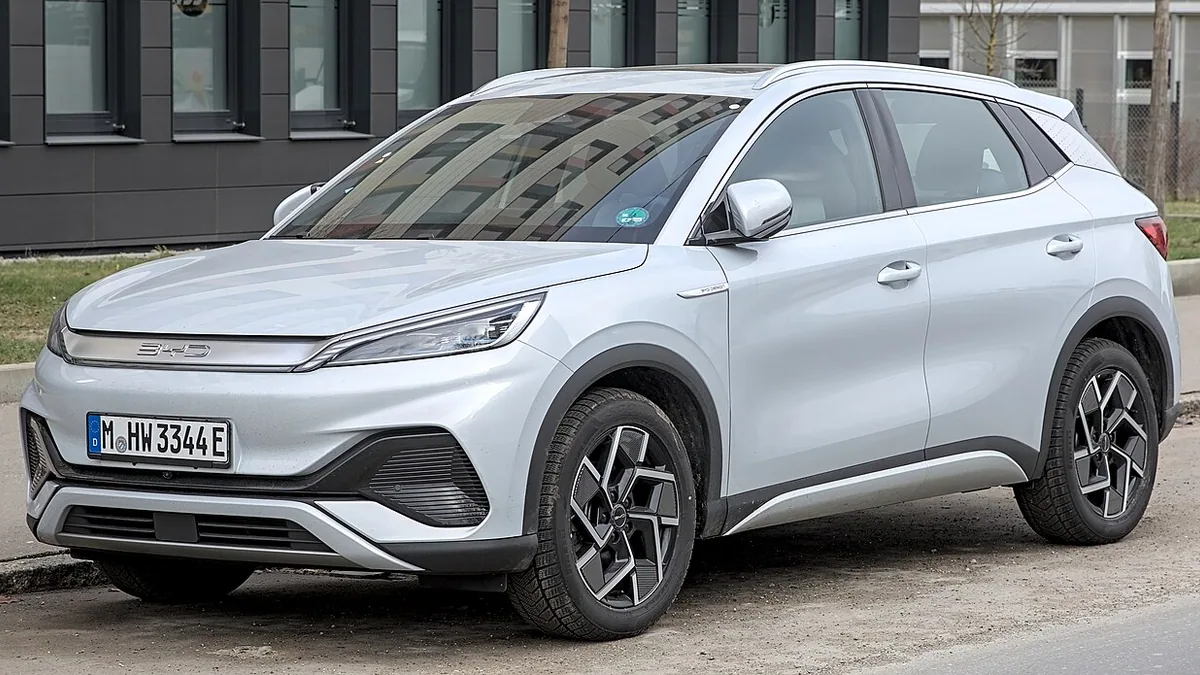
Bangladesh's electric-car conversation has moved from someday to showroom. With petrol anchored above ৳120 a litre and Dhaka traffic averaging under 15 km/h, the arithmetic has flipped: a car that costs ৳2 per kilometre to run suddenly looks cheaper than a 1.0-litre crossover. The BYD Atto 3 — sold in China as the Yuan Plus — is the model most buyers shortlist first, and it is now officially available here at around ৳46.9 lakh.
Underneath, the Atto 3 is a C-segment electric compact SUV built on BYD's dedicated e-Platform 3.0, not a converted petrol platform. It was BYD's first passenger EV for most export markets and has become its global volume seller — 500,000 units by September 2023, one million by June 2025. That production scale matters in Bangladesh, where parts availability and service confidence usually decide a purchase more than a spec sheet.
Who is it for? Mainly the Dhaka homeowner with a garage wall socket and a 40–70 km daily commute, plus fleet and ride-hailing operators clocking high kilometres. It is not yet a car for someone who drives Dhaka–Chattogram twice a month and expects a charger at every fuel pump. Here is the honest, Bangladesh-context verdict.
Key Specifications at a Glance
| Model / Variant | BYD Atto 3 Extended Range, front-wheel drive |
|---|---|
| Approx. price in Bangladesh | ৳46,90,000 (approx., Dhaka, before registration) |
| Battery | 60.48 kWh BYD Blade LFP, 400-volt architecture |
| Motor output | 150 kW (204 PS / 201 hp), 310 Nm |
| Claimed range | 420 km WLTP / ~480 km NEDC; real-world 330–390 km |
| 0–100 km/h | Approx. 7.3 seconds |
| AC charging | 7 kW Type 2 — 0–100% in about 9–10 hours |
| DC fast charging | 80 kW CCS2 — 0–80% in about 45 minutes |
| Dimensions / boot | 4,455 mm long, 2,720 mm wheelbase, 440 L (1,338 L folded) |
| Suspension | MacPherson strut front, multi-link independent rear |
| Infotainment | 12.8-inch rotating Android screen, 360° camera, 8 speakers |
| Safety | 5-star Euro NCAP, 7 airbags, ADAS (AEB, lane keep, adaptive cruise) |
| Warranty | 8 years / 160,000 km battery; approx. 6 years / 60,000 km vehicle |

Design, Ergonomics & Build Quality
The Atto 3's exterior is inoffensive rather than dramatic — a clean crossover silhouette with a closed grille, LED headlamps and 18-inch alloys. The talking point is inside, where BYD's fitness-culture theme turns up as dumbbell-shaped air vents, a treadmill-style centre tunnel and guitar-string door pockets. It sounds gimmicky but ages better than expected, and the 2025 facelift softened the louder contrast trims into grey and beige.
Build quality is solid rather than premium. Panel gaps are consistent, doors shut with a reassuring thunk, and the cabin has held up well in owner reports. Practicality suits Bangladeshi roads: a 2,720 mm wheelbase gives genuine rear legroom, the 440-litre boot swallows a family's weekly bazar run, and the raised floor keeps the seats at a comfortable height for getting in and out in tight Gulshan or Dhanmondi parking.
Engine, Ride Quality & Handling
There is only one powertrain here: a 150 kW front motor with 310 Nm available from zero rpm. That translates to a 7.3-second 0–100 km/h sprint and, more importantly, effortless 40–80 km/h overtakes — the manoeuvre that actually matters on Airport Road. Power delivery is linear and silent, with none of the wheelspin drama you get from a high-torque petrol turbo in the wet.
The battery slung under the floor keeps the centre of gravity low, so body roll is well controlled despite a 1,750 kg kerb weight. The multi-link rear suspension does a genuinely good job over Dhaka's cratered service roads, absorbing broken tarmac better than most rivals at this price. Steering is light enough for congested lanes but vague at highway speed, and the low-rolling-resistance tyres prioritise range over outright grip.

City Traffic vs Highway Touring in Bangladesh
In Dhaka the Atto 3 is close to ideal. There is no gearbox to hunt, no idling fuel burn in gridlock, and the strong regenerative braking lets you drive almost one-pedal from Farmgate to Motijheel. Air conditioning is a big draw here and it does sap range — expect 15–20 percent in a 38°C summer with the cabin pre-cooled — but the 360-degree camera and compact 5.3 m turning circle make narrow lanes and basement parking far less stressful.
Highways are the weak spot. At a steady 100–110 km/h on the Dhaka–Chattogram expressway, range falls 25–30 percent, so a realistic 290–310 km is your limit. One-way trips are fine; round trips need planning. Public DC charging along the highway corridor remains thin, so most owners treat the Atto 3 as a city car with occasional intercity capability rather than a touring vehicle.
Mileage, Fuel / Charging Cost & Maintenance in BDT
This is where the Atto 3 wins decisively. Filling the 60.48 kWh Blade pack draws roughly 63–65 kWh from the wall after losses. At current residential tariffs of roughly ৳9–10 per unit, a full charge costs about ৳600–650 and returns 330–390 km of real city driving — that is ৳1.6–2.0 per kilometre. A petrol compact SUV at ৳125 per litre and 11 km/l costs about ৳11.4/km. Over 15,000 km a year, that is roughly ৳30,000 versus ৳1.7 lakh.
Setup costs matter. A 7 kW AC wall box needs a dedicated 32-amp line and typically runs ৳60,000–1,20,000 installed, before any building-committee approvals. If you have rooftop solar, the economics get even better. Grid reliability is the real caveat — during load-shedding hours you simply cannot charge, so overnight scheduling and a full battery before storm season is basic EV discipline in Bangladesh.
Servicing is cheap by SUV standards: no engine oil, no filters, no spark plugs, and regenerative braking roughly doubles brake pad life. Budget ৳15,000–20,000 a year for inspection and cabin filters, plus faster tyre wear because of the kerb weight. Comprehensive insurance for a ৳47 lakh EV is higher than for a ৳35 lakh petrol SUV, so factor that in.
Safety Features, Braking & Spare Parts Availability
The Atto 3 carries a 5-star Euro NCAP rating with seven airbags, electronic stability control, and a full ADAS suite including autonomous emergency braking, lane-keeping assist and adaptive cruise. The Blade battery is the headline: LFP chemistry with a cell-to-pack structure that has passed nail-penetration testing without fire, which is reassuring in a country where monsoon flooding and waterlogged underpasses are annual hazards.
Braking is regenerative-first with friction backup, and the transition is smooth enough for traffic. Ground clearance is adequate but the pack sits low — avoid deep water. Spare parts are the genuine weak point: body panels, lights and sensors are import-only through the authorised distributor, so a fender bender can mean a three-to-six week wait. Mechanical consumables are better stocked, and independent EV workshops in Dhaka and Chattogram are slowly emerging.
Price in Bangladesh, Variants & Rival Comparison
Bangladesh's duty structure favours EVs with motors under 200 kW, which is exactly why the 150 kW Atto 3 lands near ৳46.9 lakh rather than ৳70 lakh. Buy through the authorised distributor and you get the full 8-year battery warranty, local diagnostic support and software updates. Grey-market or reconditioned imports can appear ৳4–6 lakh cheaper, but battery warranty transfer is often void and resale is noticeably weaker — a serious risk on a car whose battery is half its value.
Resale value is still an open question. Early official units are holding reasonably well because supply is constrained, but Bangladesh's used-car market is conservative about EVs. Expect depreciation similar to a hybrid rather than a Toyota petrol SUV. For context on conventional alternatives, see our Toyota Raize review and the Honda Vezel e:HEV, or the seven-seat Mitsubishi Xpander.
| Model | Standout Feature | Approx. Price (BDT) |
|---|---|---|
| BYD Atto 3 | 420 km WLTP EV, Blade LFP battery, ৳2/km running cost | ৳46,90,000 |
| Honda Vezel e:HEV | Self-charging hybrid, no charging infrastructure needed | ৳48–52 lakh |
| Toyota Raize | 1.0L turbo, cheapest entry, strong resale | ৳34–38 lakh |
| Mitsubishi Xpander | Seven seats, proven petrol reliability | ৳36–40 lakh |
Final Verdict: Should You Buy It in Bangladesh?
Buy it if you have a garage or dedicated parking with a wall socket, drive 40–70 km a day inside Dhaka, and plan to keep the car five years or more. The running cost saving alone — roughly ৳1.4 lakh a year at 15,000 km — offsets a large chunk of the price premium over a Raize, and you get far more power, better safety and a quieter cabin while doing it.
Skip it if you cannot charge at home, regularly drive long highway routes, or buy on a three-year horizon where resale certainty matters most. In those cases a Honda Civic or a hybrid Vezel remains the safer financial bet.
As a package, the Atto 3 is the most credible electric car officially on sale in Bangladesh today — not because it is perfect, but because the battery is genuinely safe, the range is honest, and the cost per kilometre is unmatched.