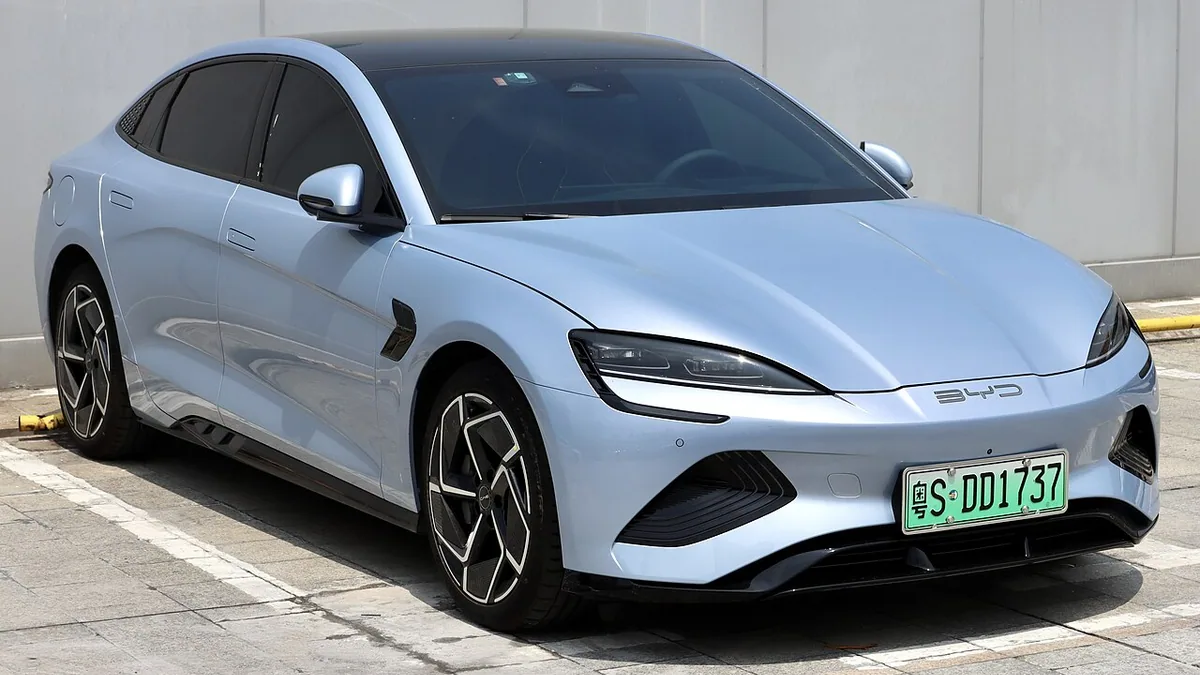
The BYD Seal is the car that moved BYD from a novelty in Dhaka showrooms to a genuine alternative to a petrol D-segment sedan. It sits above the Atto 3 in the local line-up: a low, wide electric sedan built on BYD's e-Platform 3.0 with an 800-volt electrical architecture, a structural Blade battery and up to 530 PS in Performance AWD form.
This is a research-based review. 24khobor has not driven the car. Everything here comes from BYD's published specifications, the Wikipedia model record and what dealers and owners report, and any price is an approximate market figure rather than a quotation.
Key Specifications at a Glance
| Body / segment | Mid-size (D-segment) electric sedan, 5 seats |
|---|---|
| Platform | e-Platform 3.0, 800-volt architecture, CTB structural battery |
| Battery | 61.4 kWh or 82.5 kWh LFP Blade pack |
| Claimed range (CLTC) | 550–700 km depending on pack and variant |
| Power | 150 kW / 204 PS (Dynamic RWD); 230 kW / 313 PS (Premium RWD); 390 kW / 530 PS (Performance AWD) |
| 0–100 km/h (claimed) | ~7.5 s standard; 3.8 s Performance AWD |
| Top speed | Limited to 180 km/h |
| Charging | ~7 kW AC; 110–150 kW DC, 30–80% in about 30 min; V2L output |
| Chassis numbers | 0.219 Cd drag coefficient; 40,500 Nm/deg torsional rigidity |
| Cabin tech | 15.6-inch rotatable screen, 10.25-inch cluster, 12-speaker Dynaudio |
| Comfort kit | Panoramic glass roof, vegan leather, ventilated front seats, dual wireless charging, 53-litre frunk |
| Price in Bangladesh | Approx. ৳44.9 lakh – ৳99.9 lakh by variant (dealer-dependent) |

Design, Ergonomics & Build Quality
The Seal's shape is functional before it is decorative. A 0.219 Cd drag coefficient is among the lowest for a production sedan, and BYD gets there with a low hood, flush pop-out door handles and a long single-piece taillamp. The ocean theme continues inside with wavy dashboard vents and a rotatable central screen.
The engineering headline is the cell-to-body battery. Because the Blade pack is structural, torsional rigidity is quoted at 40,500 Nm/deg against an industry average of roughly 25,000, and the floor sits lower than in a conventional EV conversion. In Bangladesh that translates to a car that should feel tight over years of broken roads rather than rattly.
For local conditions, the ventilated front seats matter more than the panoramic glass roof — humidity makes ventilation a daily need, while a fixed glass roof adds heat load in April and May. Buyers should check whether a sunshade is supplied. The 53-litre frunk is genuinely useful for charging cables.
Engine, Ride Quality & Handling
There is no engine, and that changes the buying logic. The base Dynamic RWD uses a 150 kW / 204 PS rear motor with the 61.4 kWh pack. The Premium RWD steps to 230 kW / 313 PS and the 82.5 kWh pack. The Performance AWD pairs a 160 kW front motor with the 230 kW rear unit for 390 kW / 530 PS and a claimed 3.8-second 0–100 km/h.
Chassis hardware supports the power. The Performance variant is quoted at a 50:50 front-to-rear weight distribution, and some models get Intelligent Torque Adaption Control (iTAC) plus adaptive dampers. On paper this is a rear-biased, low-centre-of-gravity sedan rather than a soft cruiser, which is unusual in this price band in Bangladesh.
Ride quality is the unknown. The references do not give wheel sizes, kerb weight or ground clearance, and those three numbers decide how a low sedan copes with Dhaka's speed breakers and flooded stretches. Ask the dealer for ground clearance in writing before you commit.

City Traffic vs Highway Touring in Bangladesh
In stop-start Dhaka traffic an electric sedan is at its best: no idling, no gearbox, instant torque and near-silent crawl. The Seal's 180 km/h limiter is irrelevant here; what matters is that 204 PS in the base car is already more than a similarly priced petrol sedan delivers at any point in the rev range.
Highway touring is where the range claim needs context. The 550–700 km figures are CLTC numbers, a cycle that flatters steady low-speed running. A Dhaka–Cox's Bazar run of roughly 400 km with air-conditioning on is realistically a one-stop trip, and the stop has to be at a working DC charger, not a three-pin socket at a roadside restaurant.
That makes the Seal a confident Chattogram or Sylhet day-trip car and a planning-heavy long-distance car. Owners should map charging points before leaving, and treat the quoted range as a best case rather than a promise.
Charging Cost, Mileage & Maintenance in BDT
BYD quotes 12.7 kWh/100 km for the Seal AWD. Converted to taka, the running cost depends entirely on the tariff you pay: a home connection on a residential BERC slab is far cheaper per kilometre than petrol, while DC fast charging on a commercial rate narrows the gap. The exact BDT figure is not confirmed in the references and should be calculated against your own bill.
Charging speed is the practical advantage. On a 220 V AC line the car draws about 7 kW, which suits overnight charging at home or a factory shed. On a 110–150 kW DC charger BYD claims 30–80% in roughly 30 minutes — a lunch stop rather than an overnight wait.
Maintenance is the quiet win. There is no engine oil, no spark plugs, no timing belt and far less brake wear thanks to regenerative braking. The unknowns are tyre cost on a heavy sedan and the price of any battery-related service outside warranty, neither of which the references confirm.
Safety, Braking & Spare Parts in Bangladesh
The structural battery is itself a safety argument: the Blade pack is load-bearing, so it sits inside the crash structure rather than hanging beneath it. The Wikipedia record lists ANCAP, ASEAN NCAP and Euro NCAP headings but does not publish scores, so buyers should ask the dealer for the specific variant's rating before treating any safety claim as settled.
Braking relies on discs plus regeneration, which means pads should last far longer than on a petrol sedan of similar weight. The bigger local risk is underbody damage — a low floor and a battery pack make speed breakers and flooded roads a real hazard, and repairs are not a roadside job.
Spare parts are the weakest link. BYD's Bangladeshi distribution is expanding, but body panels, lights and EV-specific components are not stocked like Toyota or Honda parts. Expect insurance-backed repairs and waiting time, and check the battery warranty terms in writing. The used market for electric sedans is still shallow, so resale value is unproven.
Price in Bangladesh, Variants & Rival Comparison
Bangladesh pricing for the Seal is quoted as roughly ৳44.9 lakh to ৳99.9 lakh depending on variant. That is a huge spread, and it usually reflects which trim and battery pack a dealer has landed rather than a fixed price list. Official CBU imports and any reconditioned or grey-market units should not be compared on sticker price alone — warranty, registration paperwork and software support differ.
The right comparison is not against another EV but against the petrol sedan you would otherwise buy. Below is how the Seal lines up against the models 24khobor has covered in this segment; only the Seal's price band is confirmed across our sources.
| Model | Standout Feature | Approx. Price (BDT) |
|---|---|---|
| BYD Seal | 530 PS AWD, 800V charging, CTB Blade battery | ৳44.9–99.9 lakh (approx.) |
| BYD Atto 3 | Taller SUV body, same Blade battery chemistry | Not confirmed in references |
| BYD Sealion 6 DM-i | Plug-in hybrid, no charging dependency | Not confirmed in references |
| Honda Civic | Turbo petrol sedan, deep resale and service network | Not confirmed in references |
Final Verdict: Should You Buy It in Bangladesh?
Buy the Seal if you have reliable overnight charging at home or office, your daily running is mostly city and short highway, and you want the performance and refinement a petrol sedan at this money cannot match. The 800-volt charging and the structural Blade battery are real engineering advantages, not marketing lines.
Skip it if you park on the street, regularly drive 400+ km routes without a planned charging stop, or need a car whose panels and parts a neighbourhood garage can fix. Skip it too if the only variant actually in stock is at the top of that ৳44.9–99.9 lakh band and you were budgeting for the entry figure.
For everyone in between, the Seal is the electric sedan to benchmark against. Compare it with BYD's own SUV and hybrid offerings, and with a petrol sedan, before signing — the car is excellent on paper, but in Bangladesh the ownership setup decides whether it works.
How we researched this review
This review draws on BYD's published model specifications, the Wikipedia record of the Seal's powertrains and markets, and Bangladeshi dealer price indications and owner reports. No independent instrumented testing was carried out by 24khobor.